Showing posts with label Nutrition. Show all posts

Friday, August 30, 2019

Hiker Food Kinds of Stuff


Food! Probably one of the most important things a hiker thinks about. And hikers get HUNGRY. It's the nature of the high level of activity. Your body is using lots of calories, and in colder weather, calories to stay warm too. Muscles are getting torn to shreds by constant abuse and the need of good protein to heal. Food is a necessity, and good food is a requirement to keep the hike going.

But sad to say, a lot of hikers seem to think that they can hike huge miles subsisting on potato packs and ramen. Have you ever read the back of those packages and the nutrition they contain?
Zip, zero, zilch. Nothing. No protein. No vitamins and minerals. No bone and muscle preserving calcium.

And this is what your body is saying when all you eat is that stuff. "HEY!! How do you expect me to move for you if you don't feed me right?"

Good nutrition is a must on a long arduous hike in the wilds. A good balance of proteins, carbs and fats to make everything work in sync.

Okay, so how does one accomplish that on a hike? After all, you must carry what you eat. And thankfully its a lot easier then it was some 30 to 40 years ago. Reading Ed Garvey's book when he hiked in 1975, he had to carry little cans of tuna and chicken. Now we have foil packets that are light and easy to use. Canned chicken dried in a dehydrator makes a good addition to rice and couscous mixes. Ever been to any of those Mennonite or Amish farmer's markets? Especially if you plan to have some mail drops - they have fantastic dried foods for hiking - everything from well balanced trail mixes (salty, sweet and spicy) to dehydrated veggie flakes, couscous in various flavors, to soup bases, and even these highly concentrated tiny squares that when I eat one, boy it can keep me going for a good long while. Trader Joes and Whole Foods have a great selection of dried fruits (I have become partial to dried cherries of late). Target has Simply Balanced fruit strips with no added sugar, made of fruit puree (check the labels on the strips to make sure they are fruit based). Of course there are old standbys like PB and Nutella which give good protein and fats. Some hikers even carry olive oil when the weather is really cold to add fat to a diet. And of course bars are everywhere, from the Luna bars (which are actually pretty good and last a while; even my hubby liked it though they say nutrition for women which means nothing) to Cliff bars, Power Bars, and I like Nature Valley granola bars for crunch and also the Sunbelt bars pack a good carb punch for the weight. But all the bars tend to be heavy, so watch how many you carry.

These are typical foods stuffs I have had for my meals on the trail -

Breakfasts - Cliff bar, Pop Tarts (if I carry them I take Annies), oatmeal (when cold out, add dried fruit and nuts to fortify it), trail mix, granola bars, granola cereal, small bagel and PB, and usually I eat a piece of fruit like a the all natural fruit sticks from Target or simply dried fruit, granola

Snacks - trail mix (both salty variety and sweet, though I much prefer salty like sesame sticks, flax seed chips, cheese crackers), mixed nuts, mini candy bars, Snickers, sometimes a Power bar or Luna bar if I have a tough hike that day

Lunch - the small whole wheat bagels; I found the thin round sandwich bread then have now to be very packable, tortillas, pepperoni (put in a ziploc if hot out as it can get greasy), cheddar cheese, beef sausage, jerky (I make my own), PB, raisins

Dinner - I dehydrate beef mixtures and canned chicken to add to mixes. I dehydrate peas and green beans also to add to rice mixes. I use tuna packets. I used to use Knorr mixes that have FINALLY cutout the msg. I also make my own using good noodles, non MSG broth bases (look for them in health food stores), a little cornstarch as thickener, some spices to taste, and add in dehydrated veggies, chicken or beef. There is also couscous, a turkey dinner recipe, Annie's mac and cheese (much better than Kraft and you get more in the package. Bring some dried milk to add to it and noddle mixes.). I've gotten a pesto mix (watch for MSG though or dehydrate some bottled pesto) and added it to a bag of dried tortellini for dinner. If I eat Ramen, I discard the flavor packet and bring my own seasoning in a snack size Ziploc bag, and fortify it with dried peas and green beans and dried meat. I sometimes use the Mountain House / Backpacker Pantry meals, but they are pricey for long distance hikes. Dessert - Rice Krispy bar, Little Debbies oatmeal pie, packets of Oreos, snack size candy bars, etc

For more ideas and recipes on eating healthy while backpacking, check out my article at Mother Earth Living magazine.

Extra - take a good multi vitamin with iron if you're out for a long time. Some hikers use the kiddie gumdrop ones. I use ones I know are good from a Vitamin shop and are in my maildrops.
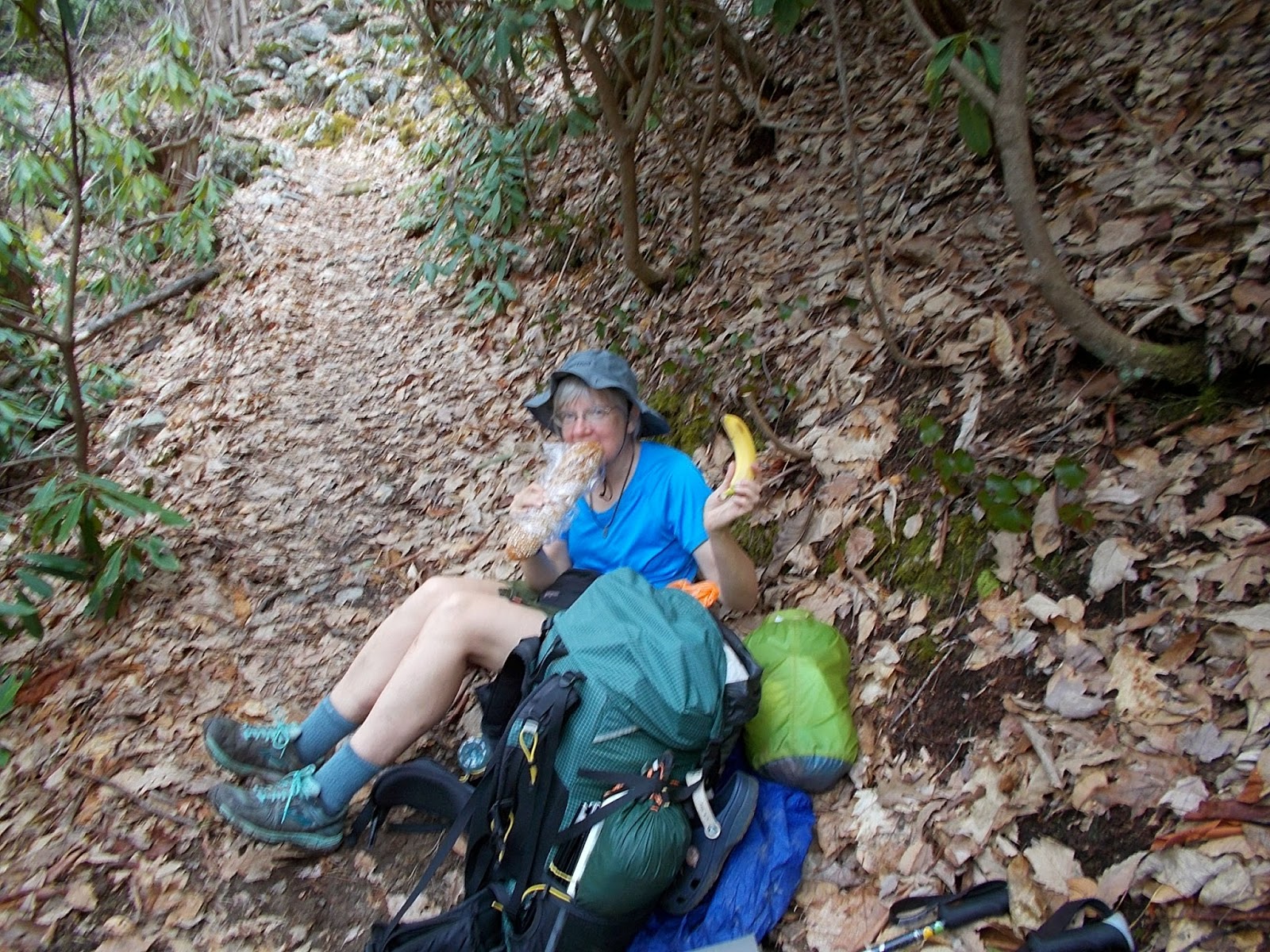
Trail Magic rocks! Especially fresh fruit.
Good wholesome food will keep you going and will help you enjoy the hike a whole lot more.

Thursday, November 01, 2018

A Thanksgiving Recipe Trailside


When you are out hiking for days, weeks, even months on end, thoughts of food occupy your mind day and night. So it was on our adventure on the Appalachian Trail. Knowing you are burning upwards of 4-6,000 calories per day hiking, it's nearly impossible to carry that much food to satisfy your need for nutrition. And eating meals trailside, day after day, one looks for creative ways to get the calories you need and still eat a good meal. Check out this blog also for hiker food kinds of stuff.


Here is a typical day on the trail. We cooked over a tiny stove called a pocket rocket that ran on a canister. We made one pot meals to share. Since our pot came with a lid, I gave Paul Bunyan food in the lid and I ate out of the pot. The pot it made out of titanium, a great lightweight option for cooking. We liked the pocket rocket canister stove to cook our meals. A simple lexan spoon or a titanium spork ( a combo spoon with fork tines, my fav) works great as a utensil. 


Lobster trailside? Not quite, but I was invited to a hiker's home for the evening while I hiked the White Mountains of New Hampshire. The invite came as a total surprise, hence the name "trail magic." The hiker (or in this case, trail angel) rolled out the red carpet for me, including a dinner of lobster and wine. Wow, I was really living it up on the trail! Towns are a great place to resupply food needs and to get a good meal, especially if a hiker can nail an AYCE restaurant (all-you-can-eat).


Ready for a THANKSGIVING recipe? Yes, you can enjoy Thanksgiving dinner on the trail with this which Paul Bunyan and I enjoyed many times on the trail. It feeds two.

(This recipe is adapted from the The Appalachian Trail Food Planner by Lu Adsmond, published by the ATC)

1 can chicken, dehydrated (canned chicken dehydrates really well, believe it or not. Don't use real chicken, it's too tough to rehydrate).
1/2 packet chicken gravy mix (I like the organic variety without msg)
1/4 tsp salt (carry more for taste)
dash of pepper
1/4 tsp poultry seasoning
(put these ingredients in one snack size ziploc bag)

1 cup stuffing mix (I like Pepperidge Farm)
1 cup unseasoned potato flakes
(put these ingredients into another Ziploc bag)

When you get to camp, let pkg 1 sit in your pot filled with approx 3 cups of water to rehydrate as you make camp. Let it come to a boil, boil for 10 minutes. Put the pot in a pot cozy to keep warm. Add package number 2. Let stand a few minutes. Adjust seasoning and liquid to taste and consistency,
Wa la, Thanksgiving dinner on the trail!


Check out my 4,000 mile Appalachian Trail Adventure on Kindle and in paperback! Find out what a teen thinks about hiking with Mom and what it's like to be a solo adventurer! Makes a GREAT gift, too.  


Friday, July 27, 2018

Overuse Hiking Issues

Overuse issues cropping up among hikers and especially those doing long distances. Unfortunately hikers sometimes believe the hike is a competition and they need to keep up with the flock. Or they feel the miles they do is too low and they ought to do more. Thus they end up doing too much for ligaments and tendons unaccustomed to the stress. Because of this, hikers end up with overuse related issues that can jeopardize their hike.

Foot and lower leg tendonitis - Just today I developed an anterior tendonitis in my right lower leg radiating to the right side of my foot from increased exercise and a flexion issue. Pain on the top of the foot may be extensor tendonitis and could be because your laces are too tight. If you have pressure point pain over a bone, a stress fracture may be developing.    

Shin Splints – I have seen many hikers developing this issue, usually after long days of hiking, doing
high miles their limbs are not used to it. Shin splints refers to medial tibia stress syndrome over the shaft of the tibia. It is directly related to doing too much too soon. The pain is felt along the thick bone of the tibia of the lower leg. Sometimes it can be in the calf muscle itself.  There could also be swelling.

Knee issues – this is probably the most common joint that suffers from overuse. The ligaments around the knee become sensitive to the loads we carry, not only of our backpacks but the stresses of uphills,   downhills, and rocky terrain. That plus longer distances puts a good deal of stress on them, leading to pain and sometimes even ligament tears.

Muscle and Body Pain and Fatigue – again, doing too much too soon can lead to weariness in the
body, especially in long distance hikers who are not adequately taking in good nutrition needed for the miles hiked. Or they skimp on drinking water. The body can turn to muscle to burn - a very poor place to find the energy needed to keep things going. Muscle wasting leads to weight drop, fatigue, and health issues once the hike ends.

What to do?

First of all, CUT the miles! If you are developing an issue like tendonitis, shin splints or knee issues, rest is important. RICE – Rest, Ice, Compression, Elevation until symptoms subside.  Take a few days off. Ice the affected extremity. Take Vit I (Advil) or Meloxicam works well too (a prescription). Taking tumeric with pepperine helps with inflammation. I have had very good results with an ointment called Penetrex. Applying an ace wrap or brace to the area sometimes helps (for me, it tends to aggravate things). Search out exercises online to help stretch the affected areas. If you are having foot pain, try relacing your shoes. If there is no relief, get checked out by a good sports medicine doctor.

Check your shoes. I’ve seen hikers that have come 800 miles in trail runners which are only meant to 
do 3-400 miles. Change your shoes ad insoles, and when you do, make sure they are the proper shoes for your foot type. Good insoles and good socks are important. And don’t forget hiking poles.

Make sure you are taking in adequate fluids and nutrition. Eating just ramen or potatoes is not going to provide the protein needed to help your muscles recover. Skimping on good foods means your body may turn to muscle of energy, and that’s not good. Eat a well-balanced meal that also contains dehydrated veggies and protein. Also take a multi vitamin. Water is needed to lubricate joints and prevent that achy feeling.

When you are ready to begin hiking again, ease back into your hiking. Do not be tempted to do too much too soon. Or you will be right back where you started. Be patient and your body will reward with with an awesome hike.

Related blogs:

Thursday, June 30, 2016

Review – Gomacro Bars

As a former nurse and now avid hiker, I am more conscious about what goes into my hiker food bag and into my body. Especially as I see hikers consuming empty calories and nutrition on their hikes. When they arrive home, their health deteriorates and more issues arise. Thus I am always on the look-out for nutritious ways to eat healthy on the trail.


I was given the chance to review the Gomacro bars. The company began with the family enduring what many do these days, the devastation of cancer, and their decision to eat healthier as a way of conquering this disease. After having good results with dietary changes, the company was born. They strive to create bars that are made of 100% plant based ingredients sourced from organic and non GMO farms. The bars are soy, gluten, and dairy free. They come in two sizes the Gomacro Macrobar and the Thrive and come in a variety of unique flavors, like blueberry lavender to chocolate peanut butter cup for the Thrive bars and cherries and berries and sesame butter and dates for the Macrobars.

I tried both the Thrive bars and the regular Macrobar on my recent backpacking trip. I ate a Thrive blueberry and lavender for a snack and instantly realized there was a big punch in a small sized bar. You can see the superfood ingredients jam-packed into the bar. Right off I tasted blueberry which was nice. But after eating a whole bar, I realized a half bar was plenty for me to feel satisfied. The bar provides decent energy and satisfied hunger for several hours. The next time I tried the Thrive, I only ate half a bar and that was plenty. So this bar goes a long way, and they only weigh 1.4 oz.

The Macrobars I used for breakfast. I noticed the outside of the bar was fairly oily, presumably so it doesn’t stick to the packaging, but I found it rather detracted from eating the bar. I could eat a whole bar and didn’t feel the fullness I did with a Thrive. The flavor was ok. It satisfied me for about two hours which is at least an hour better than I get from breakfast bars like Belvita. And I liked the idea I was eating something good for me instead of empty sugar-based calories.


All in all I like the Gomacro concept. I feel the Thrive bar is definitely worth putting into your hiker food bag. A little in that bar goes a long way, and at a mere 1.4 oz. a bar. I also like the idea I was putting wholesome nutritious food in my body so it could perform better on a hike and after the hike is done.

For more information, go to Gomacro


Our other product reviews

Thursday, July 09, 2015

Oh, My Aching Knees

 One of a hiker's chief complaints is knee issues that can spring up on the trail. A knee is a rather intricate joint with many ligaments and tendons interspersed through it to make it work as a "hinge" joint. It carries quite a load, and combined with a backpack, on uneven or steep terrain, with long miles, the load on this joint can be incredible. The knee offers a variety of complaints, so much so that is can force a hiker off the trail. 

But there are tricks to keep the knee joint functioning if a hiker treats the joint with the respect it deserves.  


Before a backpacking trip, get into a regimen of strengthening this joint. Do knee bends with a pack on your back. Do stretches for your hamstrings and quads. Knee pain often results from these muscle groups that are too tight. Learn the stretch too for ITB (illiotibial band syndrome). Runners World give a nice article on good knee stretches for the athlete.


Nutrition is a key element to healthy joints. A balanced diet is best, especially on long backpacking trips. Don't skimp in this area. Up your protein which assists in muscle healing after a hard work-out (and hiking is hard on your muscles). When you stop to rest, don't reach for a candy bar. Eat some cheese or nuts instead. Keep an adequate, consistent intake of water on your hike which helps the body lubricate the joints and brings blood to the area. Consider glucosomine, chondroitin, and msm
supplements. A product I found that is working wonders on my knee is eggstraflex that contains eggshell membrane. I have used this in place of glucsomine with good results. By far the best remedy for inflammation is Tumeric (Circumin). Be sure it contains 95% curcuminoids and Piperine for better absorption. I take it twice a day.

Use good hiking poles. They take the strain off knees, especially on downhills.


Make sure you are wearing adequate footwear and insoles. It's best to get fitted by a professional shop that knows foot types.


Watch your pack weight. An overweight pack can add more stress load to the knees. Try to cut down on any unnecessary weight.


Watch your daily trail mileage. Forget keeping up with others. Take the hike at your pace, even if that means a 6 mile day. If other hikers run past you down the hill, let 'em.


If you have done bicycling and switch to hiking, it will take time for your muscles to adapt. Give them that consideration.


For pain, an ice pack can help as well as NSAIDS (non steroidal, anti inflammatories such as Aleve or Advil).  I found the cho pat duo knee brace works well. But I try hard to limit its use. Once your knee adapts to it, it's hard to go without it. Prevention is best.  


If you find after a hike your knee is quite swollen, or you have crippling pain or the pain persists, be sure to get checked out by a sports MD. There may be other issues involved, such as strained or sprained ligaments or even Lyme Disease (which can affect joint health). 


Related Blogs:

Ankle Injuries
When Injury Sidelines You
First Aid Kit and Wilderenss Medicine
Sore and Achy


Friday, June 10, 2011

Southbound vs Northbound Part III - Outfitters and Resupply (Food, Fuel, and Gear)

My son, Paul Bunyan, hangs out at one of our resupply points NOBO in '07 - the Post Office at Unionville, NY


Resupply options vary greatly northbound vs southbound. Which is why its better if you have a good plan and a good trail guide to help you out. I used the ALDHA (Appalachian Trail Long Distance Hikers) companion to assist with my resupply points both north and south. AWOL makes a popular guide AT Hiker Guide for both northbund and southbound editions. It contains the data needed for resupply along with small maps of towns to help plan. Most of all it lets you know where to get off to buy food, fuel, gear etc. Its crucial to have a guide like this and to spend some time looking it over, especially in the beginning of a hike, to help you in that first week you are out and getting used to the rigors of daily trail life. Once you become trail-hardened in all aspects AT-wise, resupply will come natural.

I did a combination of buying food and resupplying via maildrops. You can read my blog on what I put into maildrops and places where you might need them (see the related blog listing below). I used about the same amount of hiker mail drops also for my southbound hike, with the exception of a few places. I found it easier to have someone back home do my thinking for me with regards to food, so when I arrived in town I could relax and enjoy my time off rather than spend bunches of time hitching for a ride or at the store trying to figure out food options for five days of trail. But I also liked to have cheese, fresh bread, and other food stuffs fresh from the store. Check out this blog about the hiker food choices I did bring.

So what are the options for resupply both in food, fuel, and gear? 

Southbound

Southbounders need to be more self sufficient as the options for resupply and outfitters are fewer and far between. They are faced with the 100 mile wilderness, but there are options for food and for gear resupply if you need it.

 White House Landing is the choice for many hikers after they leave Abol Bridge (which itself has a small grocery store). WHL caters to hikers with a resupply store, lodging and food. You can also mail home excess gear here. But it is not cheap. After all, its out in the middle of nowhere, across a lake,and requires a water taxi (which they provide). So expect to pay $$ while you are here. Another option if you have gear issues is to hitch a ride out a Gulf Hagas (there is a parking lot there and day hikers are usually in abundance esp on weekends) to the town of Greenville, Maine that has two outfitters (one is pretty good) a motel, and a great restaurant with the best broasted chicken. Hitching back to the trail can be a bit of an issue though, and it also requires a small fee to access the logging roads, payable at the entrance station. But if you are having gear issues, (we had some last year with broken water pumps and in need of Aqua Mira) this is an option unless you can wait until Monson. Shaws in Monson does have a small hiker store also, but call ahead to see what they have in stock (they usually carry fuel canisters, socks, some hydration, etc). They are also equipped to shuttle you to the larger outfitter in Greenville if you need it or you can hitch.

Other good towns to resupply farther along in Maine are Stratton and Rangeley. Caratunk has a post office where you can send yourself a mail drop (as long as it remains open, check your AT guides for updates). Some elect to go to Northern Outdoors for food, etc, but this requires a hitch. There is a small grocery store down the road from the resort, but I found it had little when I was there. So a mail drop is a good option, and the postmistress there was hiker-friendly.
Once you hit Gorham, NH resupply gets easier, and you can pretty much rely on the guidebook for town resupply options. However with rumors of post offices possibly closing like in Glencliff, NH, a mail drop to the Hiker Welcome Hostel  will work to get you to Hanover. There are outfitters at Gorham (limited gear), Pinkham Notch (limited), Lincoln, Hanover, Killington, Rutland, Manchester Center (a good one and a great hostel, Green Mountain House run by Jeff. Be sure to stop here). A small outfitter exists in Kent but with mixed reviews. Your next best place for an outfitter after that is Delaware Water Gap. Then Cabelas at Port Clinton (NOTE - at Port Clinton, PA there is a big Wal mart and a buffet place. Good spot now to resupply). Then Harper's Ferry. And so on. My favorite outfitter is Rockfish Gap Outfitters at Waynesboro, VA. They are well known too for warranty issues. So be sure to stop here and tell them Blissful sent you! From there on outfitters and town stops abound. Check your guides for where they are at. However, as late fall approaches, some services that cater to NOBO hikers are closing up for the season. Like shuttle providers and even small grocery stores (like the one at NOC which closes by early November). So plan accordingly.

Northbound

Mountain Crossings at Neel Gap, GA. The trail goes right through it.

Northbound has it much easier in the resupply route early on. Services such as stores, hostels, shuttle providers, etc cater to the northbound hiker with start dates at Springer Mtn from late Feb through April. Resupply is not an issue if you have a guidebook to know where they are. Just three days after Springer is a full service outfitter Mountain Crossings to help with your gear needs. They also accept mail drops and do have food for sale. After that, there are eager providers to help the needy hiker. Outfitters are modestly spaced out, usually good enough to obtain a fuel canister if you use it among other things. There is an outfitter in Gatlinburg, a great one in Hot Springs, and in Johnson City from Erwin if you get a hitch. Damascus has 2. Daleville has an outfitter right beside a huge Kroger grocery store (best of both worlds). Then Waynesboro's great outfitter and so on northward (see Southbound above). Towns are readily available about every four days.  And lodging options abound. And don't forget either, whether you go north or south, the great delis and hot dog stands of New York, a highlight of my hike as far as culinary lunches.

North or South, you can find what you need with a little planning.

Related Blogs:

What Goes in Maildrops
Maildrop List for the Appalchian Trail
Thru Hiking the Appalachian Trail on a Budget